👋 A Brief Introduction

I am currently a third-year Ph.D. candidate at the Hong Kong University of Science and Technology (HKUST), supervised by @Prof. Guang Zhang from HKUST-GZ and @Dr. Zhong Li from MSRA.

My past research has focused on sample selection and sample quality assessment across the full LLM training lifecycle. Recently, I have been exploring two directions:

  1. Multimodal Data Selection: Studying how data selection strategies should adapt to multimodal corpora with extremely low signal-to-noise ratios.
  2. Specialized Text Data Selection: Understanding what domain-specific data, such as agentic trajectories and long-context documents, actually contributes to LLM training, and developing principled criteria for selecting examples that provide useful capabilities and learning signals.
Research Across the LLM Training Lifecycle From earlier stage-specific selection to multimodal & specialized data
Pre-training Stage 1
DoGraph · Stable training
D3 · Sample ordering
ACL 2026 · ICML 2026
Annealing Stage 2
DirEct · Principled sample selection
ICML 2026 Spotlight
SFT Stage 3
HardPT · Hard-sample tuning
CUBE · Reasoning quality assessment
ACL 2023 · ICLR 2027 Under Review
Current Focus Ongoing
Multimodal · Cross-modal selection
Specialized Text · Long-context & agentic
Full-Lifecycle Quality

My work has been published at venues including NeurIPS 2026, ICML 2026 (one paper selected as 🏆 Spotlight), ACL 2026, ACL 2023, ACL 2025, ICAIF 2025, and ICASSP 2026 (🏆 Oral). I also serve as a reviewer for leading conferences such as NeurIPS, ICLR, and ICML (selected as 🏆 Gold Reviewer).

📝 Selected Publications (Data Strategy)
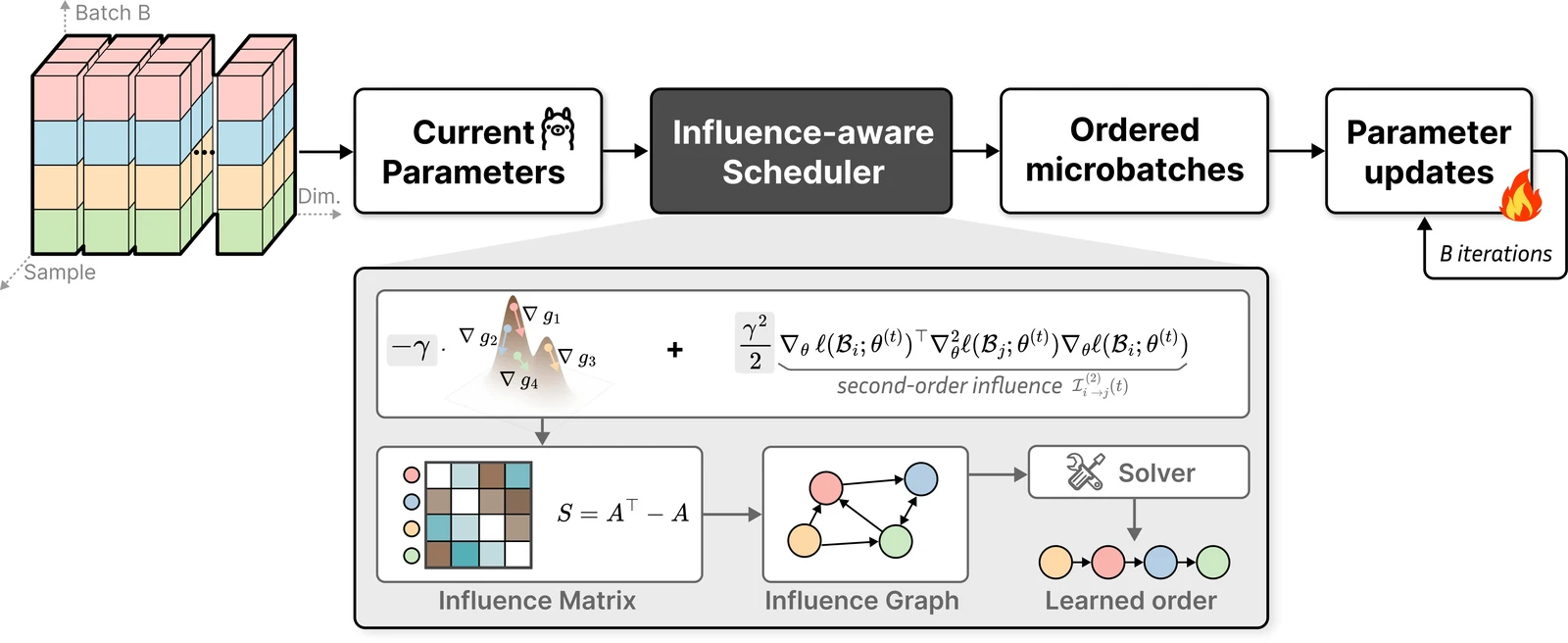
D3 influence-aware data scheduling framework
Scheduling overview. Influence-aware ordering from pairwise batch interactions to a learned training trajectory.
ICML 2026 CCF A · CORE A*

D3: Dynamic Directional Graph-Constrained Data Scheduling for LLM Training

Yuanjian Xu, et al. · MSRA

D3 models gradient and curvature interactions between micro-batches as a directional graph, then solves for a training order that improves the optimization trajectory.

Geometric comparison of stable training and annealing
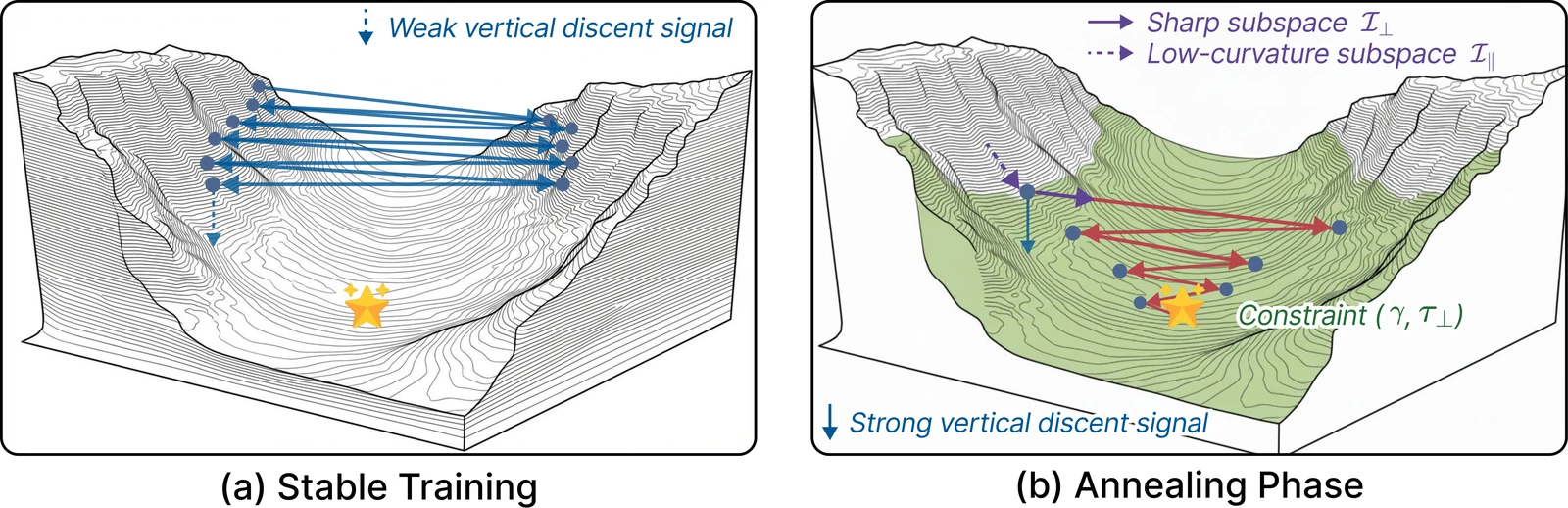
Annealing geometry. Transverse noise is suppressed while the useful descent signal is preserved.
ICML 2026 Spotlight 🏆 CCF A · CORE A*

Towards Efficient LLMs Annealing with Principled Sample Selection

Yuanjian Xu, et al. · MSRA

DirEct characterizes the geometry of LLM annealing and selects samples that reduce sharp-direction noise while strengthening progress along the low-curvature valley.

PCA projections of domain gradients across training epochs
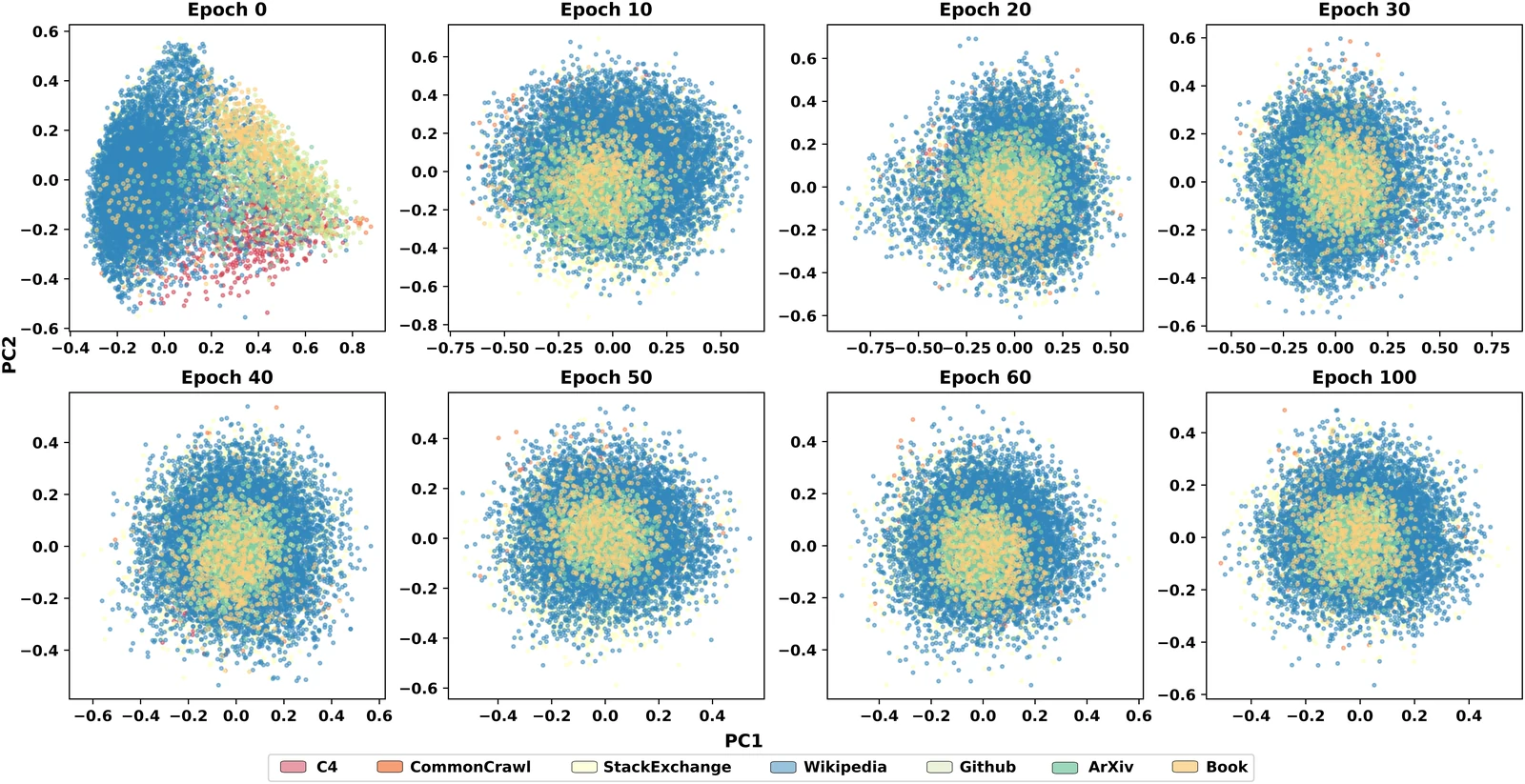
Training dynamics. Domain-specific gradient clusters gradually overlap as training proceeds.
ACL 2026 CCF A · CORE A*

Rethinking Data Mixing from the Perspective of Large Language Models

Yuanjian Xu, et al.

The paper connects domain distributions with gradient dynamics. DoGraph uses these relationships to optimize data mixing and explain how domain weighting affects generalization.
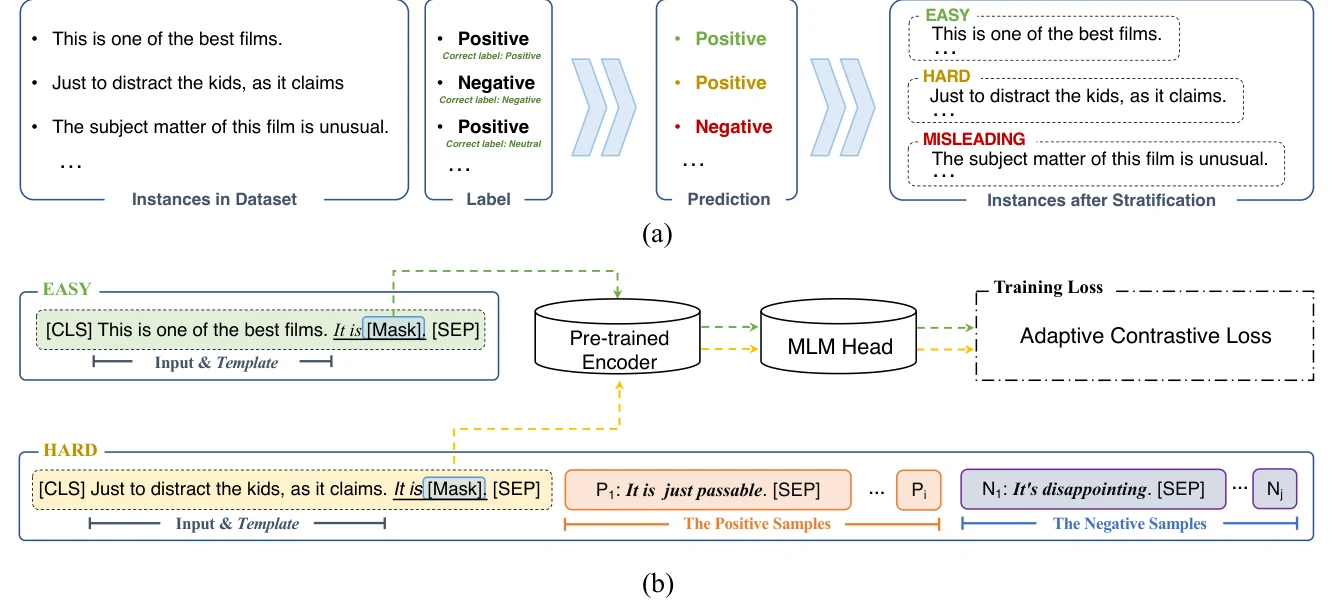
HardPT sample stratification and adaptive contrastive learning architecture
Method overview. HardPT separates easy, hard, and misleading samples, then constructs contrastive supervision.
ACL 2023 CCF A · CORE A*

Hard Sample Aware Prompt-Tuning

Yuanjian Xu, et al. · THU AIR

HardPT identifies examples that provide useful difficulty and builds adaptive contrastive batches so prompt-tuning focuses on informative hard samples.
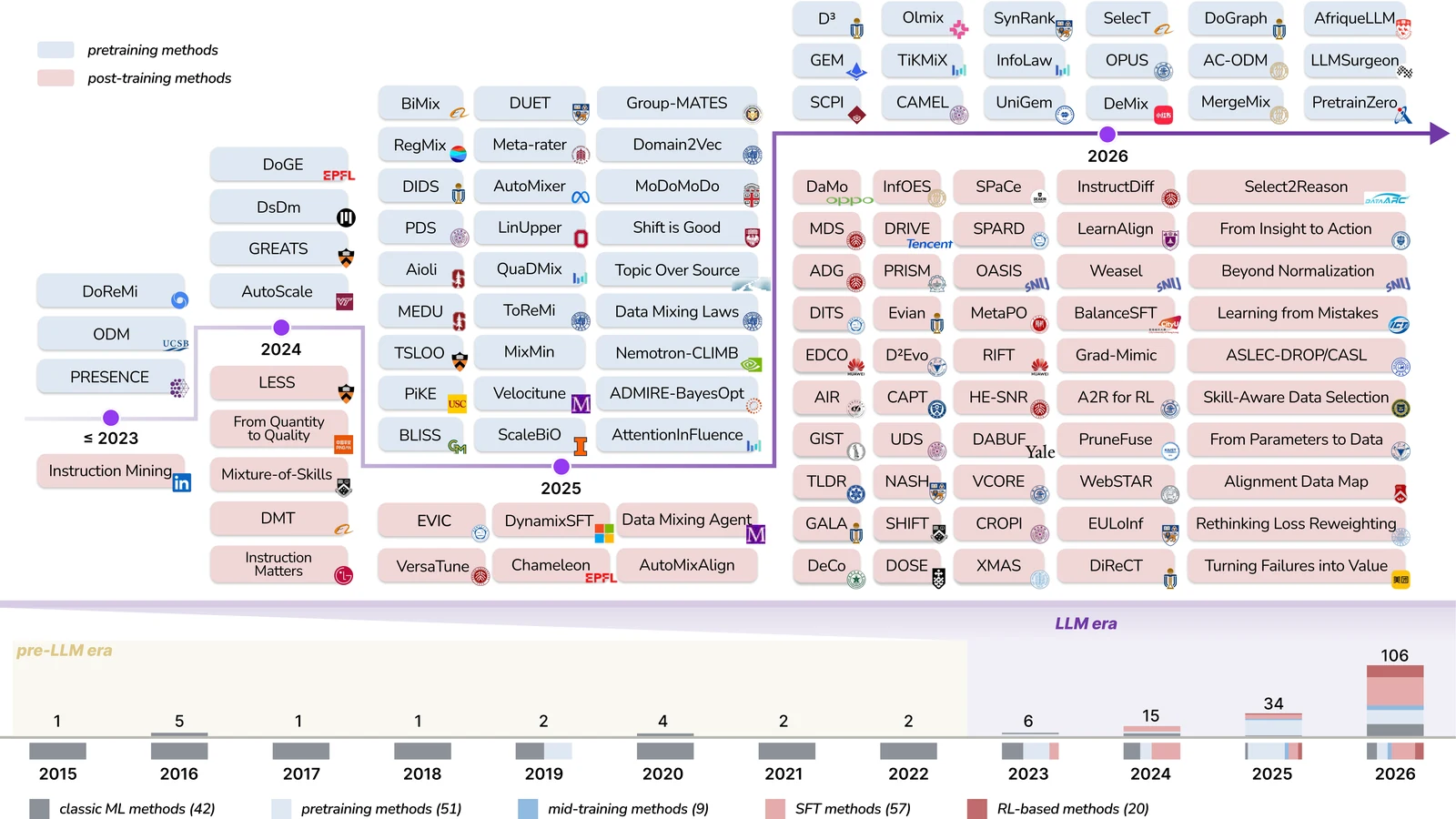
Landscape of data strategies across the LLM training lifecycle
Survey overview. The landscape connects pretraining and post-training data strategies across the LLM lifecycle.
Under Review at ACL 2027 · Survey CCF A · CORE A*

Data Strategy in Action: Identifying High-Quality Corpora Across the LLM Training Lifecycle

Yuanjian Xu, et al.

This survey organizes data strategies by training stage and decision granularity, showing how quality criteria and selection policies evolve across the full LLM training lifecycle.
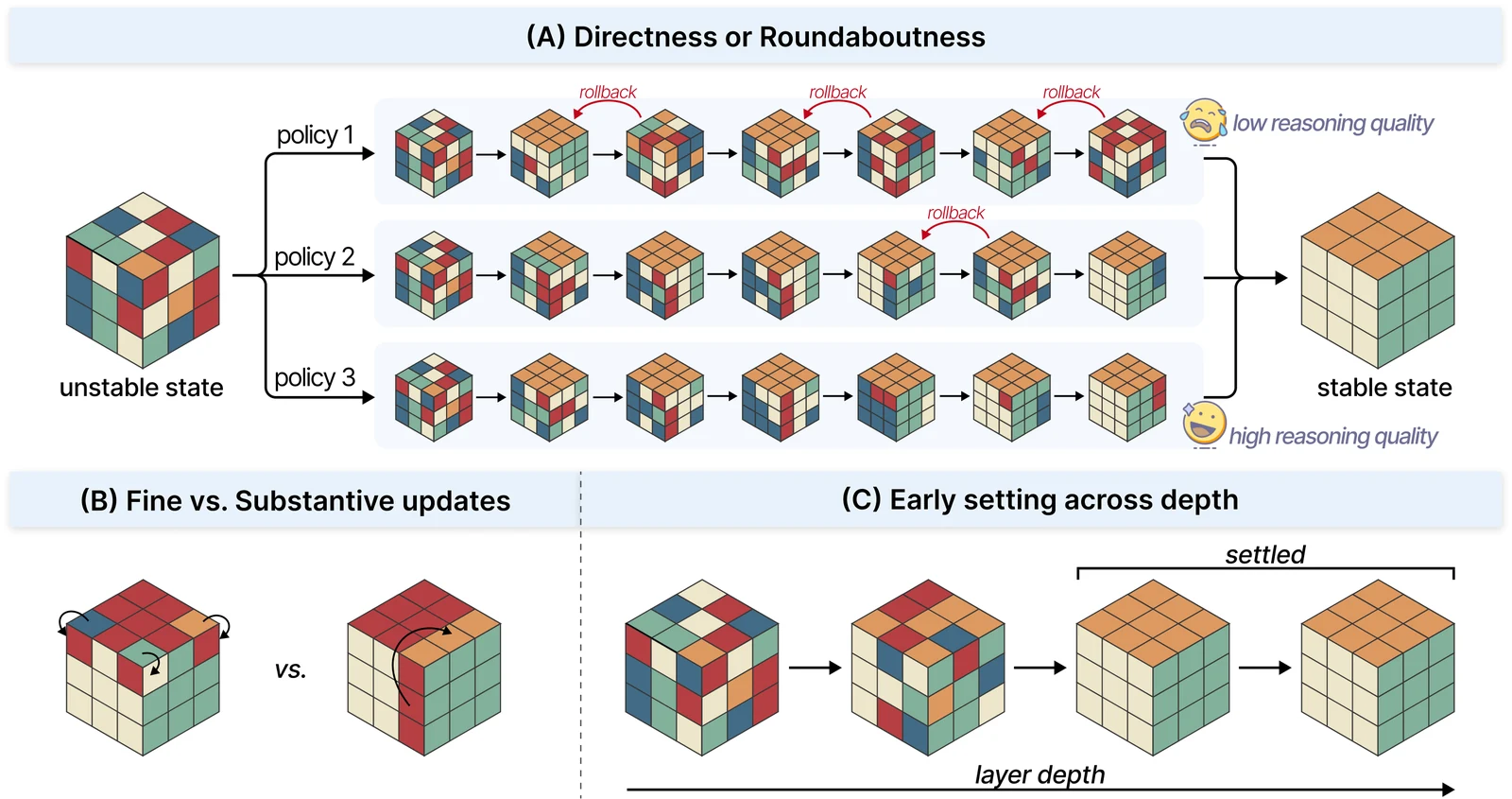
CUBE geometric signatures illustrated with Rubik's cube trajectories
Method overview. Directness, update scale, and early settling describe the internal geometry of reasoning.
Under Review at ICLR 2027 CCF A · CORE A*

CUBE: Benchmarking Sample Reasoning Quality from Internal Geometric Dynamics in LLMs

Yuanjian Xu, et al. · Tencent Hunyuan

CUBE evaluates reasoning samples through layerwise geometric dynamics, measuring whether internal trajectories are direct, substantive, and convergent.
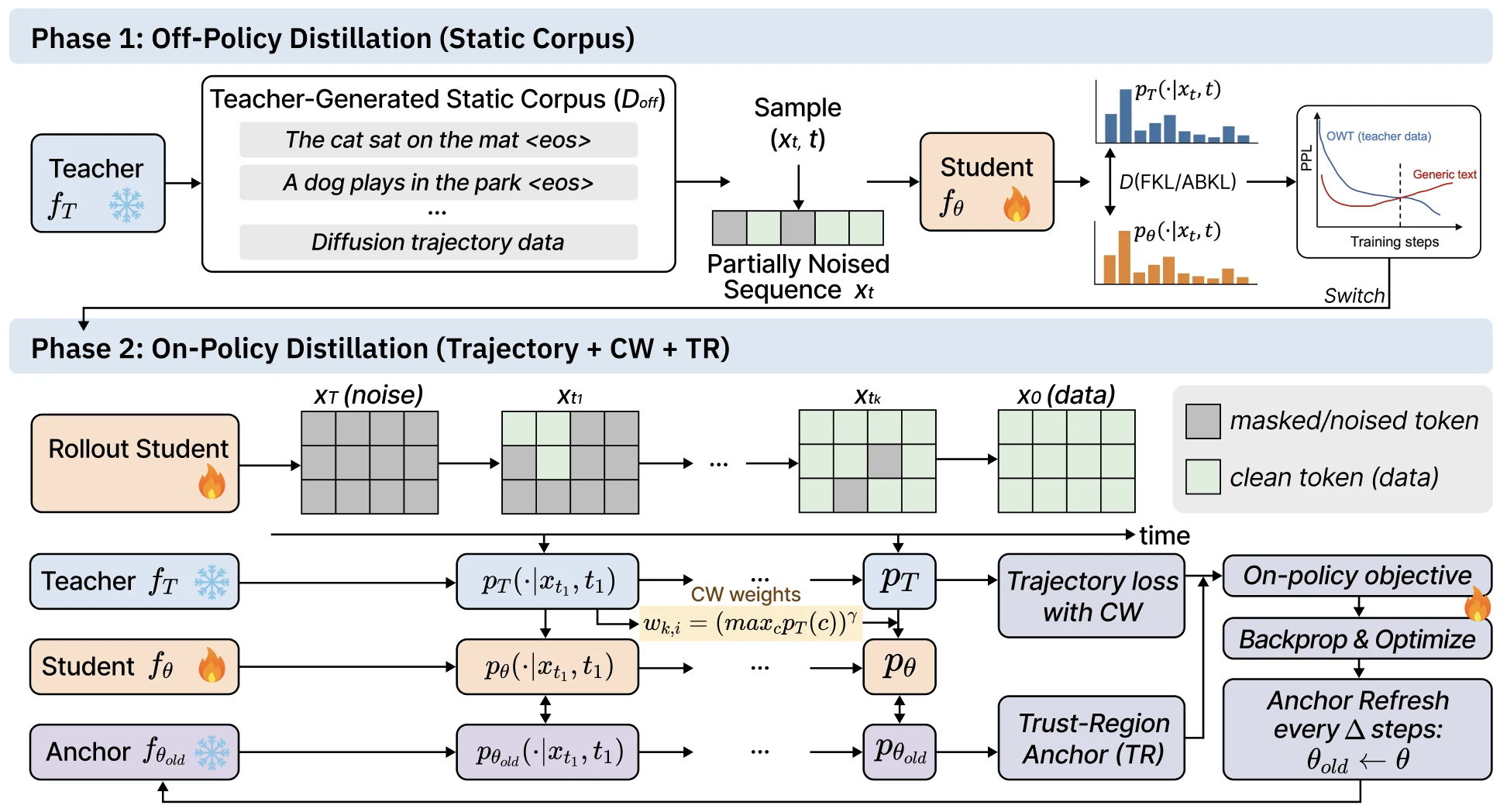
Two-stage knowledge distillation framework for diffusion language models
Method overview. Static off-policy distillation is followed by on-policy learning from the student's own diffusion trajectories.
NeurIPS 2026 CCF A · CORE A*

Rethinking Knowledge Distillation for Diffusion Language Models

Yuxuan Sun, Yuanjian Xu, et al.

We identify the distribution mismatch behind classical distillation for diffusion language models and combine a stable off-policy foundation with on-policy trajectory learning.

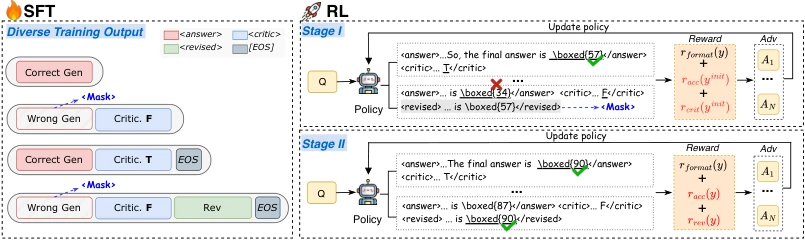
Structured reasoning training framework with targeted SFT and staged reinforcement learning
Framework overview. Generation, verification, and revision provide targeted signals for structured reasoning supervision.
Under Review at ICLR 2027 CCF A · CORE A*

Structured Reasoning for Large Language Models

Jinyi Han, Zixiang Di, Zishang Jiang, Ying Liao, Jianing Hao, Yuanjian Xu, Yanghua Xiao

We structure chain-of-thought trajectories into generation, verification, and revision components to assess reasoning quality and provide targeted supervision.

📝 Selected Publications (Corpora & Benchmarks)
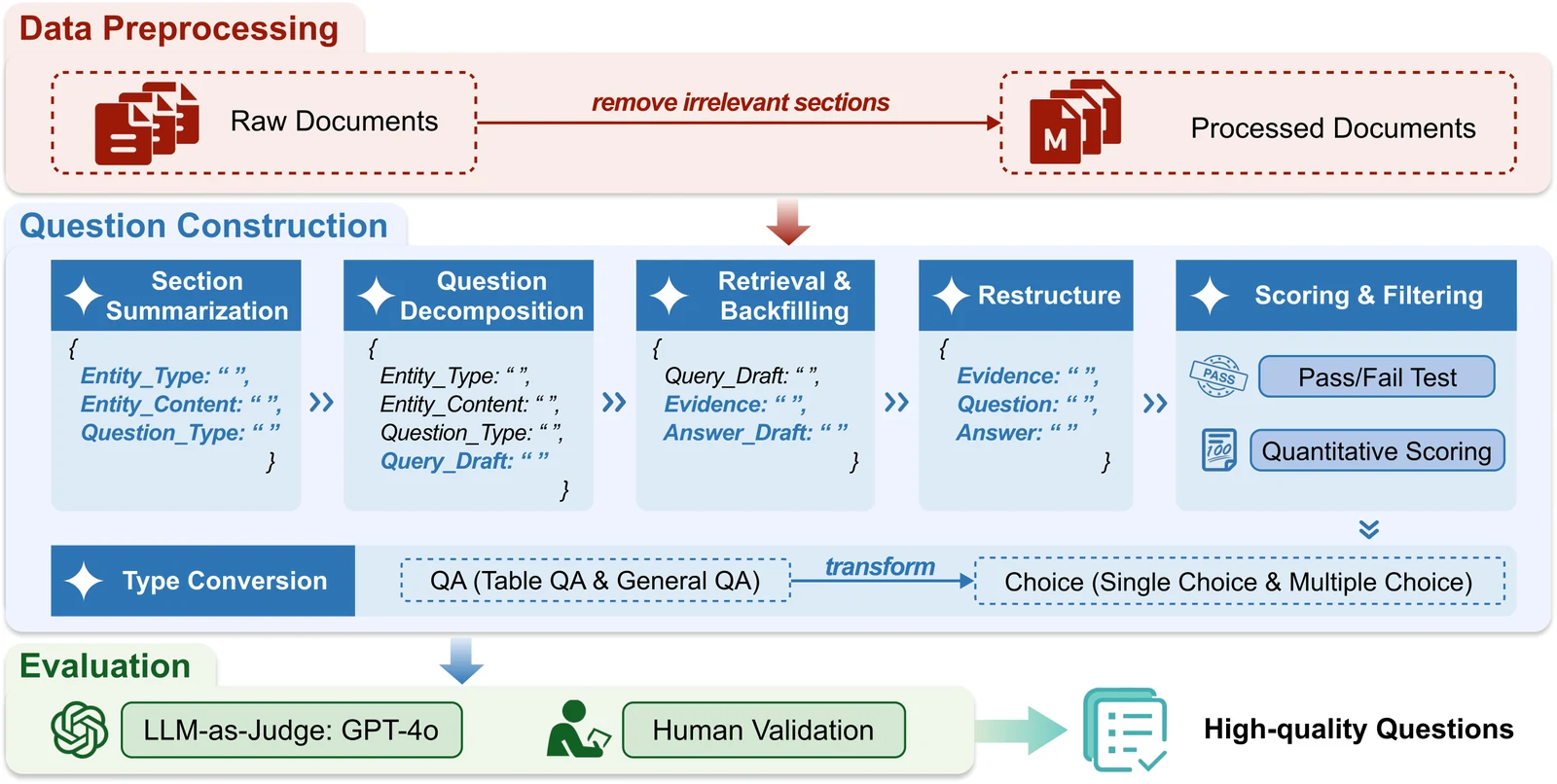
BizCompass benchmark construction pipeline
Benchmark construction. BizCompass turns business documents into validated, high-quality reasoning questions.
ACL 2026 CCF A · CORE A*

BizCompass: Benchmarking the Reasoning Capabilities of LLMs in Business Knowledge and Applications

Yuanjian Xu, et al.

BizCompass provides a construction and validation pipeline for evaluating LLM reasoning across business knowledge and application scenarios.

FinRipple knowledge graph construction, injection, and market alignment framework
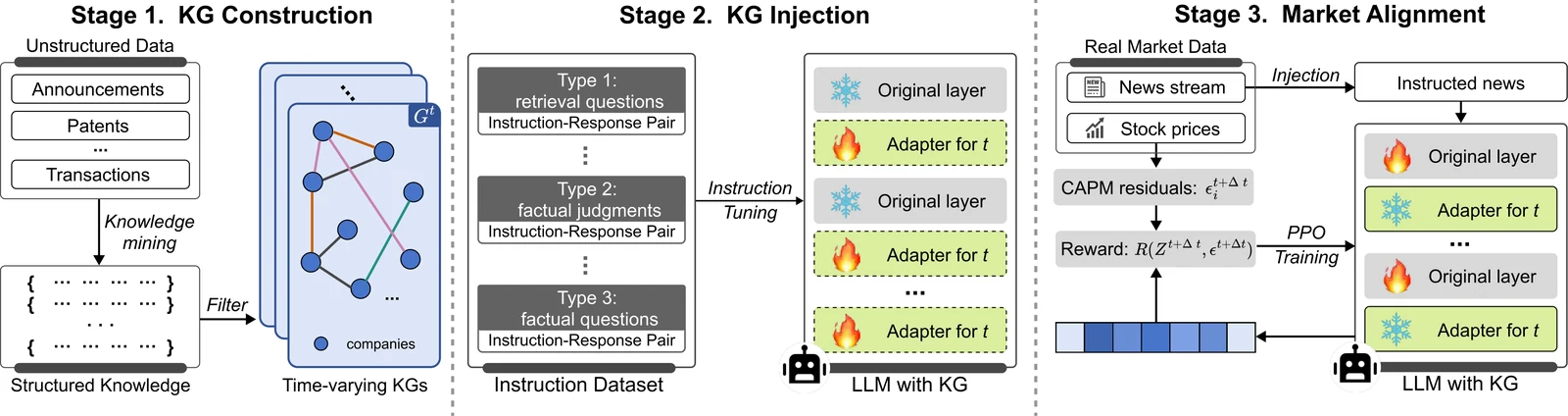
Framework overview. FinRipple connects time-varying knowledge graphs, instruction tuning, and market alignment.
ACL 2025 CCF A · CORE A*

FinRipple: Aligning Large Language Models with Financial Market for Event Ripple Effect Awareness

Yuanjian Xu, et al.

FinRipple defines event ripple effect prediction and aligns LLMs with dynamic market structure through knowledge graph injection and market-feedback optimization.

Composition and domain coverage of the Skill-Use benchmark
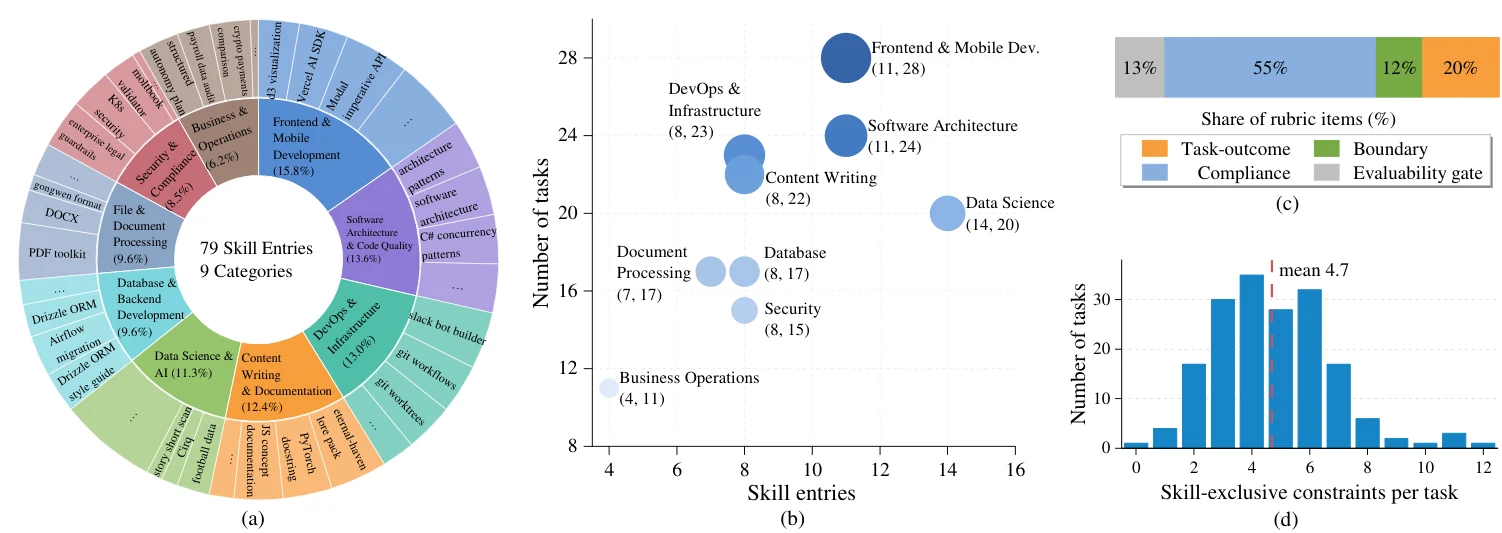
Benchmark composition. Skill-Use covers 79 skills across nine domains with rubric-based agent evaluation.
Under Review at ACL 2027 CCF A · CORE A*

Skill-Use: Can LLMs Actually Use Skills in Agentic Harnesses?

Jinyi Han*, Yuanjian Xu*, et al. · Equal contribution · Tencent Hunyuan

Skill-Use evaluates whether LLM agents can recognize, invoke, and correctly apply reusable skills, rather than merely solving tasks from parametric knowledge.

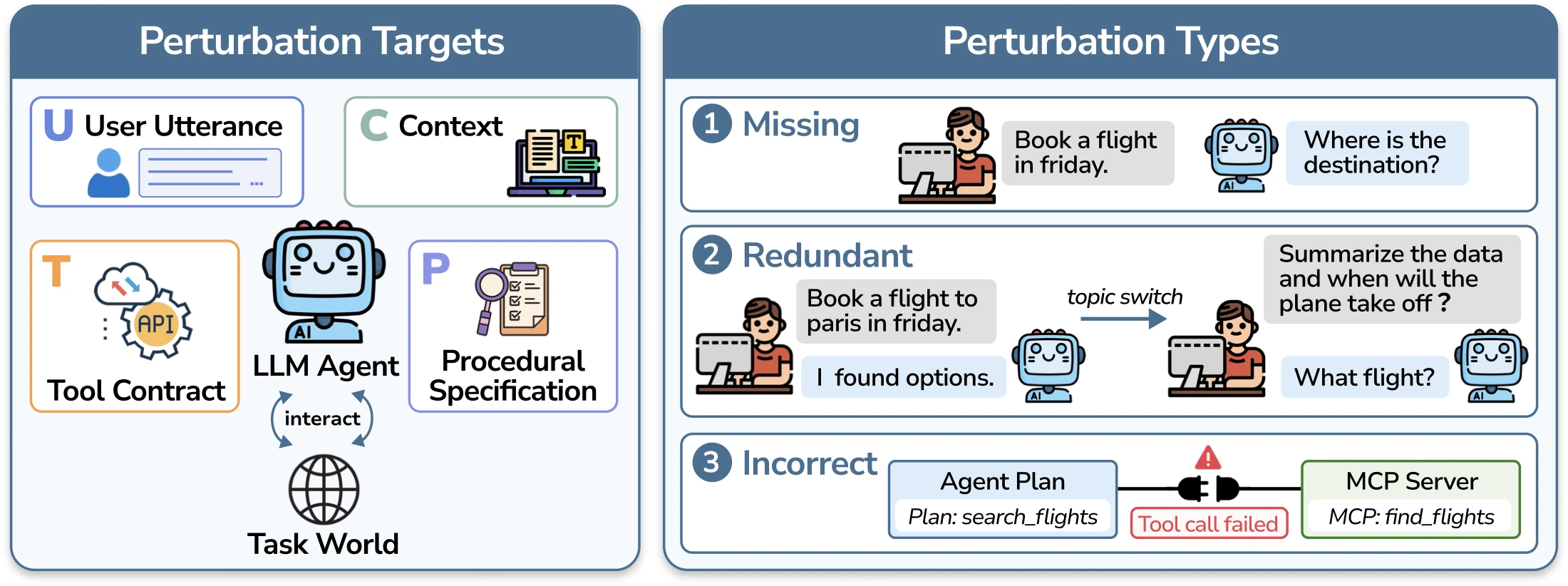
NoiseBench perturbation targets and perturbation types for agentic environments
Perturbation design. Four interaction targets are crossed with missing, redundant, and incorrect information to create 12 noise families.
Under Review at ACL 2027 CCF A · CORE A*

Can LLMs Stay Robust in Noisy Agentic Environments?

Yuanjian Xu, et al. · Tencent Hunyuan

NoiseBench evaluates agent robustness across four interaction targets and three perturbation types, revealing whether models recover from missing, redundant, and incorrect information during interaction.
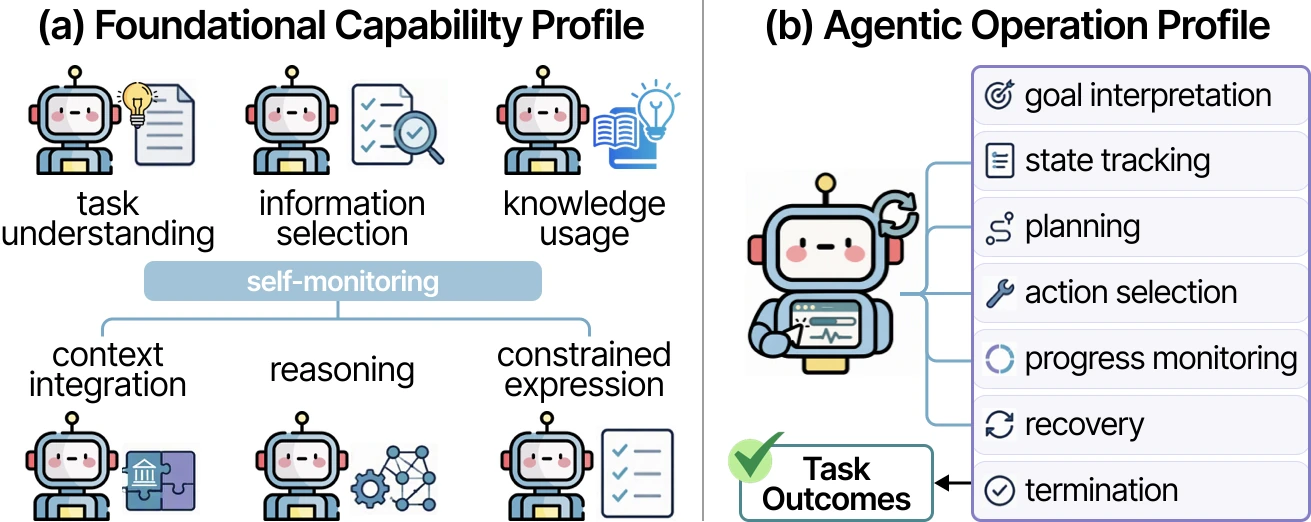
Framework linking foundational capability profiles, agentic operation profiles, and task outcomes
Framework overview. Foundational capability profiles are linked to agentic operation profiles and task outcomes.
Under Review at ACL 2027 CCF A · CORE A*

Bridging Foundational and Agentic Capabilities of LLMs

Wei Guo, Yuanjian Xu, et al.

We connect benchmark-derived foundational profiles with trajectory-derived operation profiles, exposing capability realization gaps and improving prediction of agent task outcomes.

Other Papers

  • [ICASSP 2026 Oral 🏆] Yuanjian Xu, et al. HGAN-SDEs: Learning Neural Stochastic Differential Equations with Hermite-Guided Adversarial Training [ Paper]. [CCF B] [CORE A]

  • [ICAIF 2025] Yuanjian Xu, et al. LENS: Large Pre-trained Transformer for Exploring Financial Time Series Regularities [ Paper]. (Leading conference for AI in Finance)

  • [Under Review at AAAI 2027] Yuanjian Xu, et al. Rethinking Neural SDEs under Shifting Data-Generating Processes. [CCF A]

🎓 Education

I am currently pursuing a Ph.D. in Fintech at the Hong Kong University of Science and Technology. I received my Master’s degree in Computer Science from Peking University, and my Bachelor’s degree in Computer Science from Nankai University.

🔬 Academic Activities

  • Teaching Assistant, Advanced Statistics (FTEC 5030), HKUST

💼 Internship

Tencent
Tencent Hunyuan Top Talent Research Intern

Working on quality assessment for unlabeled samples and the design of frontier agentic benchmarks.

Tsinghua University
AIR, Tsinghua University Research Intern

Worked under the supervision of Prof. Zaiqing Nie. Contributed to the Meituan Nutrition Knowledge Graph construction. Investigated hard sample problems in NLP and proposed HardPT, published at ACL 2023.

Microsoft Research Asia
Microsoft Research Asia (MSRA) Research Intern

Worked under the supervision of Dr. Zhong Li. Focused on data selection and training order optimization for large language models. Proposed the D3 method and an annealing training framework, both accepted at ICML 2026 (annealing work as Spotlight).

JoinQuant
Joinquant (Billion-scale quantitative fund) Research Intern

Worked under the supervision of PM Ruixiao. Developed tick-level generative and representation models for high-frequency trading. Addressed key challenges including non-equally spaced data and market randomness.

🏆 Honors and Awards

  • 2026 Top 10% Intern, Microsoft Research Asia (MSRA)
  • 2023–Present Full Ph.D. Scholarship, Hong Kong University of Science and Technology
  • 2021 Award for Excellent Academic Excellence, Peking University (Certificate No.: H2021000170320)
  • 2021 Air Star Plan, Tsinghua University, Institute for AI Industry Research (AIR)